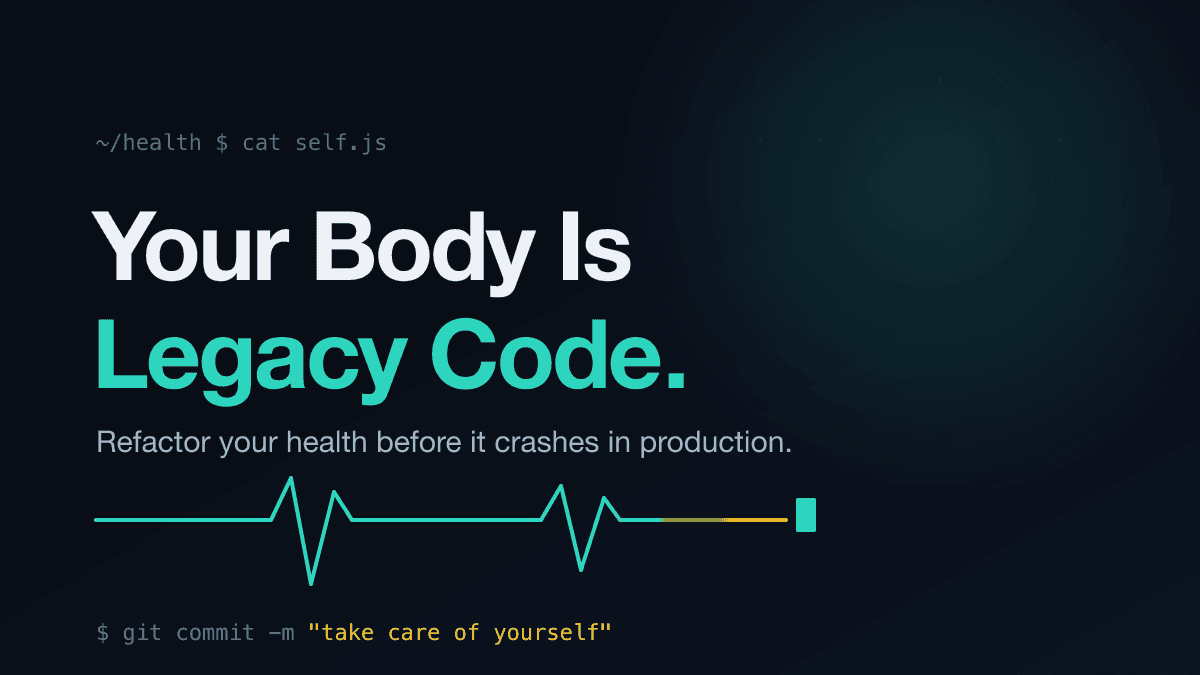
Refactor your health before it crashes in production. A developer-friendly look at sitting, eye strain, RSI, and burnout, with the small fixes that actually work.
Yogesh Mishra
3 months ago4 min read
Your body is the oldest, most critical system you run. It has been in production your whole life. And unlike your code, it has zero rollback.
~/health $ cat self.js~/health $ git log --onelinea1f9c2 fix: drink water7b3e10 perf: walk 2 minc4d8a9 refactor: posturee2f1b7 chore: sleep 8hHEAD → take care of yourself
We ship clean code. We patch leaks. We watch uptime. But the machine running all of it, us, stays unmonitored.
AI TL;DR
// tags Health · Burnout · Ergonomics · DeveloperLife
— Reactions
If this hit, tap a reaction. It tells me what to write next.
Sitting is an independent risk. A daily workout does not fully cancel a day of sitting still. - Eyes take the daily hit: digital eye strain is almost universal in our work. - Hands and wrists are your primary input device, and there is no npm install for a damaged nerve. - Burnout builds silently, like unhandled stress in a background queue, until the system crashes. - The fixes are small: move every hour, rest your eyes and wrists, protect your mind, and put health on a schedule like you would monitoring and backups.
We optimize everything except ourselves
Picture the status panel for the one service you never check:
systemctl status you.service
api.latency → 42msnewfast
app.uptime → 99.98%newgreen, of course
memory.leaks → patchednewyou fixed those last sprint
you.health → unmonitoredmodifiedno logs, no alerts, no dashboard
We monitor uptime and patch leaks. We ignore the machine running it all. This post is a quick code review of that machine: the four files most likely to crash, and the small refactors that keep them alive.
1. Sitting is the new smoking
This is not a slogan. Sitting is an independent risk factor. The more hours you sit, the higher the risk, and a single daily workout does not fully cancel it out.
The longer you sit, the higher the risk of early death
% higher risk of death
Each bar is the % higher risk of death compared with sitting under 7 hours a day. Figures from the brief, verify before publishing.
Read it left to right: sitting 8 hours a day is about 5% higher risk than the under-7-hour baseline, and it climbs from there. At the high end, roughly 11.7+ hours a day, studies link a 30% higher risk of early death. The fix is not a marathon. It is breaking up the sitting.
// movement.js: the smallest possible fixsetInterval(() => standUp(), 45 * MINUTES); // stand 2–3 mintakeCallsStanding(); // free standing deskuseTimer('Stretchly'); // it nudges you, so you don't have to remember
2. Eyes: the daily hit
Digital eye strain is almost universal in our profession. A meta-analysis of 103 studies (66,577 people) found two in three of us are affected: dry eyes, blurry vision, headaches, an aching neck. With ~7 hours of screen time a day, it is our single most common occupational issue.
66%
Screen workers with eye strain
7 hrs
Avg screen hours per day
20-20-20
The rule that helps
The fix is one rule you can remember forever:
The 20-20-20 rule: every 20 minutes, look at something 20 feet away for 20 seconds.
3. Hands and wrists: the bug nobody reviews
Your hands are your primary input device. Repetitive Strain Injury (RSI) is the career-ending bug that no pull request catches, until it is already merged into your body.
25%
Computer workers reporting RSI symptoms
9.6%
Confirmed carpal tunnel
0
npm packages that fix a damaged nerve
Roughly 1 in 4 computer workers report RSI symptoms. There is no npm install for a damaged nerve. The fix is to refactor your workstation, then your habits.
; .ergonomics.iniwrists = neutral ; not bent up or downelbows = 90deg ; relaxed, close to the bodyfeet = flat ; on the floor or a footrestmonitor = eye-level ; top of screen at eyebrow heightbreaks = micro ; short and frequent
4. The mind: a silent production outage
Burnout does not throw an error. It builds quietly, like unhandled stress piling up in a background queue, until the whole system goes down at once.
The developer mind, by the numbers
% of developers
Self-reported across large developer surveys. Source: brief, verify before publishing.
You cannot patch what you cannot see. The first step is to admit the queue exists, and to drain it before it overflows.
The stuff nobody schedules
Good systems have monitoring and backups. So should you. None of this is glamorous, which is exactly why it gets skipped.
life.checklist
1
Annual checkup = your monitoring dashboard
important
Once a year, look at the metrics before they alert. Catch the slow leaks early.
2
Health insurance = disaster recovery
important
You hope you never need it. You set it up anyway, because the cost of not having it is total.
3
Yearly blood test = pre-deploy health check
optional
A cheap test that tells you what is actually happening under the hood before you push another year.
§
36 years. Zero sick days for himself.
My father worked for 36 years. To him, work was worship. He gave it everything.
He gave his health nothing.
Today, he carries the cost, not one problem, but many. He did everything right for his job, and nothing for the system running it.
Work is worship. But health is more than worship. Without your body, there is no work, and no worship left to give.
“
I am sharing this so you don't repeat it.
Yogesh Mishra
§
Don't wait for the crash
You would never ship a system with no monitoring and no maintenance window. Give your body the same respect.
1
Move every hour
2
Rest your eyes and wrists
3
Protect your mind
~/health $ git commit -m "take care of yourself"~/health $ git push origin healthier-you✅ pushed. HEAD → take care of yourself
References
These figures come from the sources below. A few, the 30%, the 66%, the 1 in 4, are paraphrased from the original studies, so verify each link before treating any number as exact.